Monday, August 24, 2009

FROM THE ARCHIVE: The Trial of Miles


As I prepare for this weekend's Marathon Clinic, there's little time for a new post. Therefore, in the spirit of "Renew-Reuse-Recycle", enjoy this nugget I wrote a couple years back to my college guys -- a far cry from 26.2, yet appropriate given the end of the IAAF Champs that featured USA's first pair of metric mile medals in...forever?

Also, since it's fall and I'm yet again stricken by the "Coaching Bug", enjoy this non-therapeutic*, performance-related post!

(*unless, of course, your "illness" is consistently poor mile performances!)


*****
The "Shocker Mile" Race Strategy

The mile race (English or Metric) holds a special place in the hearts, minds, and guts of almost everyone. Perhaps not everyone's raced one, but most (by Executive Order!) were forced to run at least one in their lives.

As such, we've nearly all been prey to its perfectly cruel combination of distance and intensity: too long to dead-sprint, too short to "pace". On the track, four laps -- symmetry. Simplistic. Calculated.

The biggest challenge of the mile race is how one positions oneself for both optimal placing and fastest possible time. What I have found is that these two goals are not mutually exclusive.

*****
Back in college, we did workouts called "Recover on the Run". Quite simply, you ran up a short hill, then ran aggressively over the top -- in essence, maintaining or increasing pace while forcing recovery "on the run". We carried this over into track, where we simulated this feeling by running 1000m repeats: the first 400 at 3K/5K pace, the middle 200m at mile pace, and the last 400 back down to 3K/5K.

This is a great workout because of the gear-shifting involved. It builds overall strength while also developing the ability to shift gears -- a priceless commodity in competitive racing.

A few years ago, while doing this workout solo, it occurred to me, "Why not race like this?" To me, it seemed the perfect solution to the two biggest issues of a mile race:

(1) Slowing way down after 400m
(2) Running terribly slow, mid-3rd lap, "waiting" for the race to be done

The Basics

Simply put, this strategy involves two simple "moves", one at 400m and one at 1000m.

That's it.

It seems simple. It seems easy. It might even seem asinine. But before closing your browser, stick with me:

A Typical Mile -- Running Fast the Hard Way

Below is a break-down of a "typical", effort-based mile performance, broken down by 200m segments (time in seconds in parentheses):

200m (31) -- out hard and quick for positioning
400m (32) -- finding a position, keying in on competition
600m (33) -- hitting the 400m "fast", you "settle in"

Stop here: do you see what is happening? With each successive lap, you are SLOWING DOWN A SECOND PER LAP!

809m (34) -- you sit behind in a pack. Half mile split is still pretty good
1000m (35) -- the guys in front of you are slowing; you don't move around them 'til the end of the lap.
1200m (34) -- THE GUN LAP. Time to play catch-up. The field is strung out and you're well behind the guys who got out really hard early.
1400m (33) -- you're passing a few people, but you feel like you're running all-out.
1609m (32) -- Last lap. All-out. Dead. The typical mile finish.
--------------
Total 4:24

Why did this person run 4:24? Because "that's how fit they are"? No. It is because they allowed typical race dynamics to dictate their energy expenditure. Specifically, they fell into a "slow-down" gear by which they slowed 1 second per lap. And, to snap out of that and speed up, it takes an incredible amount of physical and mental energy.

Using the same first 400m, let's execute the "Shocker" strategy to see how it works:

200m (31) -- out hard and quick for positioning
400m (32) -- finding a position, keying in on competition; You also look ahead of you to monitor runners 5-10m ahead that burst out faster than you.
600m (32) -- "Move" #1 -- Using a smooth, efficient effort, you move up in the race field to the pack ahead of yours, typically 5-10m ahead. This pack ran 30-31 for the first lap, but they are now "settled in" to 32s. You settle in with them at the end of this lap
800m (32) -- let the pack drag you around, staying relaxed and composed.
1000m (33) -- you continue to lock in to this pack, but you are looking ahead to the next 1-2 competitors 5-10m ahead, anticipating your move at the 1000m mark. This keeps you focused and aggressive.

STOP. Look at this pacing. Rather than slow 1 second/lap, you have latched onto a pace-pack that dragged you along at an even pace. Through only slightly more effort, you are now FIVE SECONDS FASTER at the K.

1200m (33) -- "Move #2" -- the runners in your existing pack are slowing down. You move up in the race field to the runners you spotted earlier, running ahead 5-10m. Over the course of this lap, you reel them in and settle in off their shoulder.
1400m (32) -- time to compete. The runners you caught are faster and more competitive: they're trying to shake you, but you hold on tightly, allowing them to drag you through the penultimate lap.
1609m (31) -- you drop the hammer. The momentum of having moved up progressively through the race fuels a terrific finish
--------------
Total: 4:16

What a huuuuge difference! Eight seconds faster. Seems pretty tough, but which pacing strategy looks more smooth and less stressful?

*****
Inexperienced, mentally-unfocused runners tend to get out hard and "hope" they feel well enough to compete at the end. If you want to be a tough, competitive runner and realize your potential, you have to take control of your race and mandate success! Deciding to move up after 400m (1 lap) and after 1000m (2 1/2 laps) put you on the offensive, putting your competitiveness in your own hands, rather than the hands of the field, or whether or not you "feel good" that day.

The greatest part about the "Shocker" Plan is not simply good pacing, but the competitiveness it fuels. When you execute it well, you build up terrific momentum and confidence. Rather than "think about" when you will make your move, it is pre-determined. With 400m to go, rather than "think" and "decide", you're already rolling! Moreover, who do you think has the momentum: you -- who's been moving up -- or the other guy -- who got out hard and is dying?

Coupled by smarter pacing and progressive racing, you are already passing people, setting up a monstrous bell lap.

Sounds good, right? But how do you make it happen?

"Recover-on-the-Run" Repeat 1000s. For the runner above (whose bests might be a mile in 4:16 and a 5K in 15:00), the paces might be:

72 - 32 - 72 = 2:56

For the five-minute miler/19:00 5K:

90 - 37 - 90 = 3:37

I recommend 3x K for beginners (600m jog rest) and up to 5-6x K for advanced (400m jog rest).

Take-Home Messages:
- Move up in the field at 400m and 1000m laps. This keeps you from slowing down, makes you more aggressive, and keeps you focused and competitive for the end stages of the race!

Monday, August 17, 2009

Fall Marathon Clinic - Sunday, August 30


On Sunday, August 30, as a lead-up to Fall Marathon Season, Eugene PT rep Joe Uhan (DPT, MA, USATF Level II Coach) will present a Marathon Clinic on all-things marathoning: peak-training tips and injury prevention, nutrition and hydration, and running gear and footwear leading up to the big event. Also addressed will be:
  • "Top Ten Ways to Think Like a Marathoner"
  • Essential Running Injury-Prevention Stretches
  • Nutrition/Hydration
  • Race-Day Gear
The Marathon Clinic will be held on 8/30/09 at 9:30AM at the Eugene Running Company, Oakway Center, Eugene, OR. It is FREE OF CHARGE. See you there!

Sunday, August 9, 2009

"We Can Rebuild Him"

A recent foray onto the internet today had me stumbling across weblogs of a couple local ultra runners (Dan and Matt). As an avid trail runner/outdoor adventurer, I also consider myself an aspiring ultra runner. It's just a matter of time. But 'til then, I live vicariously through the stories shared and pictures taken.

It shouldn't surprise me that, among obstacles and challenges discussed, injury reports were sprinkled amongst the posts. When your training log not only lists daily/weekly mileage (often triple-digits) but also elevation, then you know they're putting more "wear-and-tear" on their bodies than the average woodchip shuffler like myself.

When guys like these (and I'll take the liberty of lumping myself into this category, for this example) get injured, I imagine the Monday morning water cooler talk goes something like this:
  • Cubemate #1: "Hey Dan, what's with the ice pack?"
  • Dan: "Oh, my knee's been bothering me quite a bit lately -- I had to cut my long-run short at 20 yesterday."
  • Cubemate #2: "20!?! Well no wonder why your knee hurts! "
...which invariably is followed by several "heh-heh-heh's", some head-shaking and perhaps an eye-roll or two.

Dan, or whichever one of us this situation befalls, is left standing there, frustrated and annoyed (and with a family-size bag of frozen peas Ace-wrapped to their knee!)

Why? Because it's all relative. If a person's never run a mile (let alone 20), they cannot understand how it is physically possible to do so without crumbling to pieces. However, the Dans out there are frustrated by this simple logic:

"If I can run ten miles (or 20, or even 30) a hundred times in my life,
why does my knee hurt on the 101st? "

The cubemates -- as well as most family MDs and orthopedic surgeons -- would argue the following:
  • The "Your Body Can Only Take So Much" Argument (aka "The 30 Years Rule"?)
  • The "You're Getting Too Old" Argument
Both arguments have but limited validity. Yes, the body's limits are finite -- though closer to "in-finite" than most people can possibly imagine. And Yes, we cannot do at age 90 what we can do at 20.

Instead, I'll borrow from the world of structural engineering: the material stress model:


Stress = Force/Area

where Stress is the injury-producer and Force is how we choose to treat our bodies.

Age and genetics are the biggest determinants of the amount of Stress it takes to injure: individual bodies react differently to Stress, and the same body differently across a lifespan. It also varies in accordance to training adaptation.

And Force? A lot is said about Force. However, a ten miler's worth of "Force" may seem ridiculous to one but an easy day to another. Again, adaptation.

But the forgotten variable is Area. What is Area? In the case of a building material, it is the space through which that force is distributed. The greater the area, the more that force is "shared" amongst all parts of the material.

What's Area to a runner? EFFICIENCY.

There's a reason feet pronate and supinate, knees and hips flex and extend, trunks rotate, and arms swing -- to absorb, store and release Force toward a goal of locomotion.

EFFICIENCY is the idealized distribution of Force throughout the body. And, when all other parts of the equation are kept constant -- age, genetics, adaptation, and load -- it is the only thing we can control to impact stress.

Yet it is the Forgotten Man. Few, if anyone -- including most sports med professionals and athletes, themselves (especially runners!) -- believe that Running Biomechanics can be changed -- for the better or worse. There's a belief out there that "You're stuck with what you've got", and instead, the focus shifts instead to the Force variable:

“You might want to consider transitioning to lower mileage—
--you’d be surprised how well you can still race on 30 miles a week!”


Here's what I say: "You might wanna consider optimizing your running efficiency!"

Injuries like Dan's occur for the following reasons:
  • Too much, too soon, but more likely,
  • You're doing something inefficiently, or less efficiently than you used to
It is that change in efficiency, for better or worse, that is the biggest determinant in running mortality than anything else. The crushing simplicity of that little equation, S = F/A, and the reality that the "S" it takes to cause injury gets smaller and smaller as we age, means that -- in order to continue to do what we love, something has to give: run less or run better.

It's that simple. Only The Efficient survive.

******
What does that mean to the Dans, Marks, and Joes out there? It means we must recognize the importance of form and technique, and its dynamic nature. Running is the only sport out there where little if any time is spent TEACHING someone to run; instead we're told, "Just run!", with the expectation that whatever permutation results is "OK".

Here's where The Skilled Physical Therapist comes in: the PT, by definition is The Movement Expert. That is our job. We don't diagnose visceral disease. We don't prescribe tissue-altering medicines. We watch how you move and, if need be, we intervene to change it.

This approach can be used with running form, and has been, with great success. I am living proof. My own knee injury of nearly a year was abolished -- not with RICE, massage, ultrasound -- but with a biomechanical and motor control renovation.

It didn't happen overnight. It took a team approach between me as the patient, and my physical therapist. And, like a golfer honing his swing or a pitcher learning a new pitch, it took a ton of practice, repetition, and feedback.

But it did change, and how! Besides recovering from the knee pain, it has revitalized -- and revolutionized -- my running career. Because of my increase in efficiency, my "Area" is significantly greater. The result? My form isn't perfect, but the Force my body can take -- even as a 30+ year old -- is vastly greater than anything I could handle before, even in my early 20s.

How do we do it? Here are some nuts-and-bolts examples of what we do at Eugene PT:
  • Comprehensive physical examination: What's weak? What's tight? What joints aren't moving, or moving too much?
  • Real-world gait analysis
  • Neurological/motor control testing: How do you control your body in space?
  • Sport-specific intervention: strengthening, stretching, and drills designed to promote EFFICIENCY.
So there is hope. You don't have to stop. We can get you better. We can make you faster. We Have the Technology. We Can Rebuild Him!

...and it won't even cost Six Million Dollars.

Sunday, August 2, 2009

She's got QUADS, and she knows how to use them!

Last fall I was working with a teenage girl who was rehabbing a surgical repair of her ACL, which she'd torn playing basketball. In those first couple months we employed the typical protocol: gobs of quadriceps and hip strengthening in every position imaginable. Though young and petite, in no time she was doing straight leg raises and hip abduction with up to ten pound cuff weights! Very impressive, indeed.

Then we got more functional: controlling her newly-repaired knee in standing. We did some step-ups and -- despite her Herculean abilities on the mat -- she looked like a marionette under a rather novice puppeteer! Translation: her knee control was awful. Even with practice, a mirror, and a persistent therapist, her control remained poor, especially in the absence of those inputs.

But why?

There's a conventional wisdom in the sports med world that, in order to improve body mechanics and control -- namely at the knee -- all you have to do is "strengthen the medial quad and proximal hip". Most research studies tell us the same thing: those with good control have strong hips/quads; those with poor control are weak.

I refer to this approach as The "Magic Wand" Approach: you strengthen certain muscles and POOF! -- knee control is normal!

I wish it were true. Then our jobs would be easier, our friend and family happier, and there'd be a lot less people with knee pain in the world.

"You've got the hen...the chicken...and the rooster...Something's MISSING!"

*****
Something's missing, alright.

The Sports Med world got wise. The busted out the steps, the balance boards, and the mirrors. They practiced functional movements with the patient and -- more importantly -- gave all sorts of feedback -- verbal and visual -- of their movement. The patient was able to see "right" from "wrong".

But despite this redoubled effort, we still weren't seeing ideal control. Without the mirrors and the "Don't do that!" voice to remind them, it was back to the old patterns -- the same patterns most people have used since they took their first step.

The "Don't Do That!" Approach, while better than its predecessor, still did not result in a permanent change in motor control. Perhaps this is why many that suffer ACL repairs are repeat offenders -- only with the other knee.

*****
So what IS missing?

To change how a person controls their body in space is to change motor behavior -- or how a person uses their brain, muscles and nervous system to move. In order to have true success in changing motor behavior, you must affect all three systems.

The "Magic Wand" looked only at muscle. The "Don't Do That" did 'em one better: muscle AND brain (though only the conscious brain). But still missing was the nervous system.

The nervous system covers outputs (muscles and movement), but just as important, inputs: how it feels to position joints, activate muscles and move limbs.

This brings us to a new approach: Dynamic Proprioception.

*****
Dynamic Proprioception© -- developed by Jeff Giulietti, MPT, ATC, and colleagues -- is an approach that integrates both orthopedics (e.g. muscles and joints) with neurological rehabilitation -- to enact a change in motor behavior.

According to motor control theories, we can only change motor patterns if we can FEEL the muscles actively work during the learning of new skills. Our conscious brain will then "integrate" that feeling into the new motor plan. In our step-up example in order to truly learn to "keep the knee over the foot" during a step-down activity is by FEELING the quad and the lateral hip while we're doing it correctly.

A treatment approach for knee control, for example, would begin with simple exercises aimed at gaining this sensory input -- first in static (no movement), then progressing to slow, controlled movement, then faster/more challenging movements, and finally, to functional movements.

Another way to put it is, you're making a motor control blueprint: "OK, here is what it FEELS LIKE to control your knee: feel your quad and lateral hip 'burning' with activation." Then, taking that blueprint, you apply it to increasingly demanding, complex, and functional activities, until it becomes automatic.

It's an approach with tremendous potential not only for injury rehab and prevention, but for optimization of control. "You're not hurt? Fine. Let's make you faster!"

If you're curious (or, more importantly, injured), come see us. And if that's not possible, when you are practicing that new skill, think to yourself: "What does it FEEL like? What are my muscles DOING?"

Thursday, July 16, 2009

Coburg Run In The Country

This Saturday is the Coburg Run In The Country half marathon and half marathon relay. If you're looking for a great event and a fast course, come check it out.

Eugene PT is the principal sponsor of the event, and will also offer free injury screening before, during, and following the run. Come by and see our tent!

Monday, July 13, 2009

If It Looks Like a Duck, Flies Like a Duck....but Moos Like a Cow...

When your muscle pain ISN'T.

A collegiate runner, several weeks into his indoor season, begins to experience heel pain. He first feels it at the end of a cold long run. It worsens throughout the week and flares badly following an intense indoor track workout spent circling the 200-m oval at high speeds and on his toes. Pain was bearable during but causes a limp on the cool-down...and walking to class following the track session.

What to do?

Everyone -- teammates, coaches, trainers, doctors, and most PTs -- would tell him to "R.I.C.E.": Rest, Ice, Compress, Elevate. Maybe some stretching and, if you have the luxury, some ultrasound and massage.

So that's what he did. All of the above. While doing so he rested, and cross-trained, and waited. And waited. And waited. Days turned into weeks, then months. Yet it was still painful to load -- and even to the touch -- and even seemed to "throb" at rest.

Then what? X-rays? MRI? Psychiatry?

How about some additional information?

  • The runner had NO morning stiffness or pain. Moreover, he had very little pain doing a calf raise, and even less stretching the affected Achilles tendon.

  • He also reported the heel was painful at rest -- sitting in class, or in the car on long drives between school and home -- where he reported a "burning, buzzing feeling".
  • Several weeks prior to the injury, the athlete was on winter break from school, where he was able to rest and relax doing a variety of things with his free time. However, just two weeks before injury onset, school re-started. This meant 6-8 hours per day class and 3-4 hours nightly studying, slouched uncomfortably in lecture hall chairs, or hunched over a book 'til the wee hours of the night.


It is at this point when you look at the moo-ing duck and call it what it is: A well-disguised COW. In this athlete's case, the source of his heel pain was his back.

*****
The human spine (or more accurately: vertebral column) contains (depending on how you count), 25 individual bones: 24 vertebrae and a sacrum -- a bone that serves as the keystone, connecting the pelvis to the spine, and a conduit for the violent ground reaction forces generated by each stride we take while running. Given that during easy running we transmit over 6 times our body weight in force with each step, it's no small miracle we don't rattle to pieces a mile down the road.


And between each of these bony vertebral segments flow the nerves controlling everything in our extremities: our voluntary motions, as well as sensations from the world around us, including pain.

"Flow" is a generous description. SQUEEZE is a more accurate description of a nerve's route from the spinal cord to their area of innervation. They tunnel their way, through tiny caves at the vertebrae, around other bones, between (and sometimes through) muscles until they reach their final destination.

And based on this description, it's no surprise that these biological powerlines often become squeeze, kinked, or otherwise aggravated -- with negative consequences.

Nerve Irritators: The Usual Suspects

The following structures are usually most responsible for nerve irritation and non-soft tissue extremity pain.

Vertebral Discs
Most of us have heard of "herniated" or "bulged" discs. We tend to think that disc pathology can occur only with severe injury. However, our vertebral discs are relatively mobile. Though microscopically, they can slide around between the bones and ever-so-lightly encroach on the nerve exiting the cord -- just enough to cause nerve-related pain down the chain.

Vertebral Joints
Joints connecting adjacent vertebrae lie on either side of the column, allowing for a variety of motions. If these joints become irritated -- usually by becoming too stiff -- they can affect the nerve roots that pass just millimeters above and below them. Indeed, these facet joints, themselves, can cause pain farther down into the arms and legs!

Soft Tissue
Muscles, fascia and other connective tissue can impede the smooth flow of nerves to their destination. Chronic muscle tightness -- that which comes from daily, punishing bouts of endurance training -- can compress and adhere to nerves, creating pain.

*****
In the case of our runner, his nerve irritation resulted in posterior heel pain closely mimicing Achilles tendonitis. However similar, it did not act like tendonitis (remember the Soft Tissue Rules of the Game?).

His pain description also missed the boat. While strinkingly similar to soft tissue injury -- the classic pain with weight-bearing -- there were several subtle differences that, in the end, led to calling that duck a cow.

Pain Behavior: Soft Tissue v. Nerve

Here's a list of differences (some more subtle than others) between soft-tissue and nerve irritation:

Pain Location
- Soft Tissue: "Point-tender" (able to point to one specific area of greatest pain)
- Nerve: large, undefined area, capable of "moving around" ("around the heel, sometimes on the inside of the ankle...")

Most Painful
- Soft Tissue: In the AM, first beginning exercise and/or at fatigue
- Nerve: gradually worsening, worst with spinal loading/impact

Hurts to Stretch
- Soft Tissue: YES
- Nerve: RARELY

Hurts to USE
- Soft Tissue: YES
- Nerve: Usually only in weight-bearing (putting compression on spine); RARE to have any pain out of weight-bearing (e.g. resisted dorsiflexion in sitting/supine)

Morning Pain/Stiff
- Soft Tissue: YES
- Nerve: RARELY

Pain at REST
- Soft Tissue: RARELY (unless injury is acute, or acutely flared)
- Nerve: YES

WEIRD sensations: burning, aching, pins-and-needles, hypersensitive to touch
- Soft Tissue: RARELY
- Nerve: YES
*****
So You Think It's Not Tissue: Now What?

As "big picture" health care professionals, whenever we get a referral diagnosis, our first thought is, "What else could this possibly be?"

When nerve pathology is suspected, we confirm it with:
  • A thorough subjective (pain onset and behavior, history of back pain, or related "odd" limb complaints?)
  • Nerve/spine special testing
  • Spinal mobility and stability testing
Armed with this information, our approach is as follows: "make the abnormal, normal"!

Treating Nerve-Related Pain

Our injured runner had the following problem list:
  1. Poor back mobility: his flexion was OK, but he was limited in extension by at least 50% (e.g. he could not do a full backbend, which a man of his age and fitness should be able to do)

  2. Poor lumbopelvic stability: he demonstrated poor core strength and activation during running

  3. Poor posture: he reported sitting, standing and lying in poor, flexed postures.
Our treatment appoach was "making normal" those three things: restoring back mobility, increasing stability, and addressing posture -- at school, at home, and in the car.

After less than two weeks of this simple treatment approach, this runner's pain reduced enough for him to resume training, and within four weeks was gone completely.

Keeping it at Bay: Tips for Good Back Health

Mobility. Spine mobility is the most important factor in alleviating -- and preventing -- back and extremity pain. Three "gold standard" flexibility milestones:
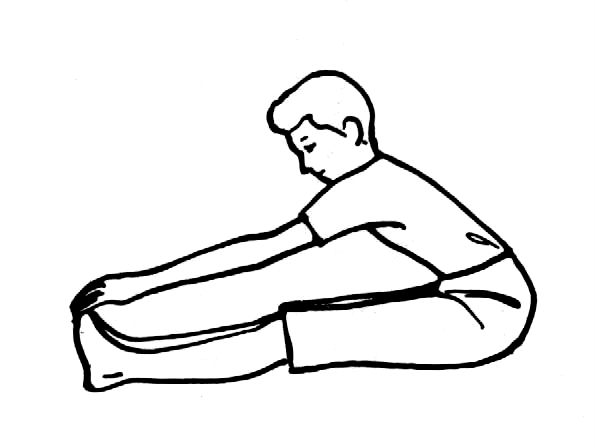
  • Touch your toes. One should be able to touch his or her toes, while keeping the knees straight.
  • Lying backbend (aka "the upward dog"). One should be able to come close to locking out elbows on this modified push-up, while keeping their pelvis on the floor.
  • Lumbar rotations. Lying flat, flex your hip up to your waist and "fold over". One should be able to touch the knee to the ground while keeping the other arm firm to the ground.
Stability. Not only having strong abdominals and back extensors, but using them in life. A qualified PT or other healthcare professional can assist you in achieving this end.

Posture! Watch your posture in whatever you do: sitting, standing, lying. Stay out of prolonged stressful positions, especially flexing forward.

*****
So, next time you think you've got a duck on your hands, treat it as such. But if it's not improving -- and you start to hear some "moos" -- you just might have a cow on your hands.

Saturday, July 4, 2009

B2B RESULTS

Finally posted HERE. No team results yet.